
EKGs as a Transformative Approach
EKGs offer a transformative approach to enterprise data management by efficiently connecting and contextualizing both
- information across data silos and
- external data sources,
regardless of their underlying data formats and models.
Unlike traditional databases that store data in isolated tables or systems, EKGs model information as a dynamic network of interconnected entities and relationships, reflecting the complexity of the real world. By meaningfully connecting all relevant data and information, EKGs enable business users to see the full context and quickly grasp the entire picture.
Real-World Example: A Swiss Cantonal Bank
Let’s consider a Swiss cantonal bank that wants to utilize its customer data to identify high-risk customers, ensuring compliance with regulatory requirements and thereby avoiding sanctions. This is a recurring knowledge-intensive task (KIT) in banks’ “Know Your Customer” (KYC) process.
Knowledge-intensive Task in KYC
This KIT requires a thorough analysis of customer data (i.e., personal details, transaction histories, business relationships, sources of funds, the identification of politically exposed persons (PEPs)) to verify the legitimacy of financial activities and identify potential risks or suspicious behavior, while ensuring compliance with local and international regulations (e.g., Anti-Money Laundering Act, FINMA guidelines, VSB regulations).
Multidisciplinary involvement
Such an analysis involves various teams such as Relationship Managers, Compliance Officers, Risk Analysts, and it is desirable to ensure links to the relevant information sources to ensure consistency across departments.
By utilizing an Enterprise Knowledge Graph, the bank can view all relevant customer information, risk dimensions, and regulations that are significant to its specific goal in one place, linked together and prioritized based on their importance for an in-depth analysis.
EKGs and the Triple Structure
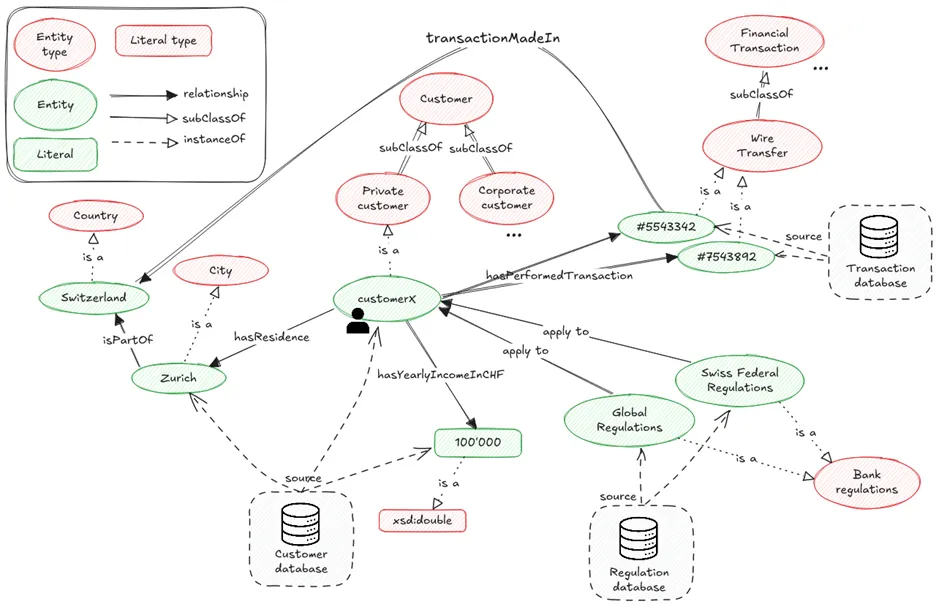
Through their triple structure, Subject-Predicate-Object, EKGs capture knowledge in human-like sentences. For example, the statement
- “CustomerX — hasYearlyIncomeInCHF — 100'000”
makes information easily understandable for business users. In this structure, subjects and objects are nodes (entities), while the predicate is an edge (relationship) that connects them. Each triple connects with others, forming a graph-like structure. For example:
- “Customer X — hasResidenceIn — Zurich”
- “Zurich — isPartOf — Switzerland”
This implies that Swiss federal regulations apply to Customer X. In addition to the Swiss federal regulations, EU regulations and global regulations also apply.
Figure 1 visually represents this scenario in an Enterprise Knowledge Graph. The red nodes represent entity types, while the green ones represent the individual entities or data.
From Insight to Decision-Making
EKGs also enable companies to uncover hidden insights and understand the relationships between different data points, allowing for informed decision-making.
Case study: Offshore Transaction
An example of a conclusion supporting informed decision-making: Let’s imagine a scenario in which our CustomerX opens an account in the British Virgin Islands (BVI) and transfers CHF 500,000 to their bank account, stating “investment purposes,” but fails to provide supporting contracts or tax declarations. In this case, all conditions of both regulatory sources (federal and global) must be checked to evaluate the customer.
If a private customer holds undeclared assets in an offshore account in a high-risk region and attempts to transfer more than CHF 100,000 to the bank account without stating a clear economic purpose, they will be classified as high-risk regarding potential tax evasion and money laundering.
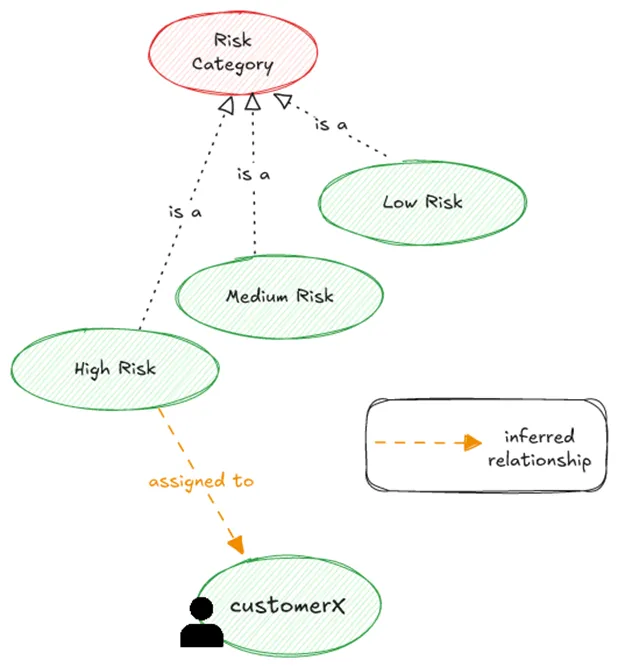
Therefore, our CustomerX is classified as “high risk.”
Figure 2 shows an extension of the previously described EKG with the newly derived statement “High Risk — AssignedTo — CustomerX.”
Inference Engines in EKGs
Deriving new knowledge logically is another capability of Enterprise Knowledge Graphs, achieved with inference engines. This reasoning ability is also useful for validating data against specific constraints. For example, one can develop constraints from compliance guidelines that regulate the aforementioned KYC, to automatically check the extent to which a customer complies with these regulations.
Human Expertise and Knowledge preservation
The previous example also shows that EKGs enable the capture and integration of human expertise (i.e., in the form of facts and rules) with data. This is a useful capability for companies, which, for instance, has the potential to address the challenge of knowledge preservation, an increasingly critical topic for companies today.
EKGs supporting AI Systems
Finally, EKGs bring structure and context to data-driven and AI systems, making their outputs more
- accurate,
- explainable,
- transparent, and
- reliable
—> ultimately increasing trust in them.
The same applies to generative AI applications and agentic AI workflows, where EKGs support AI models in producing factually correct, context-aware outputs while reducing hallucinations. They enable better personalization, efficient retrieval-augmented generation (RAG), and dynamic knowledge updates, thereby ensuring that AI agents remain current and relevant.
Conclusions - Trust, Regulation and Market Recognition
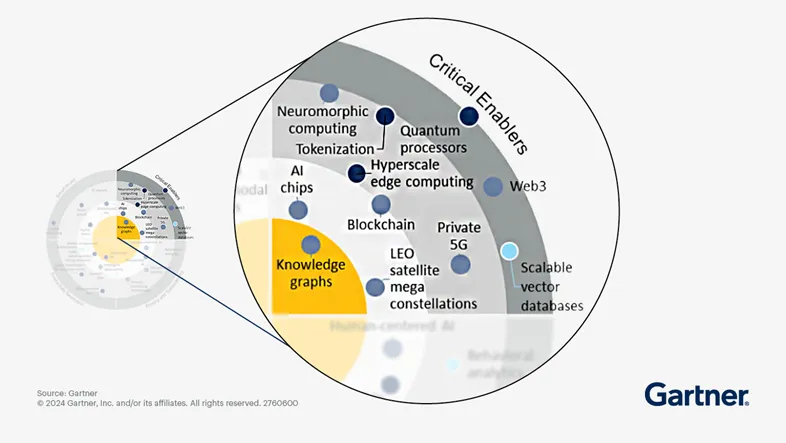
Trustworthy AI systems are no longer just a priority for highly regulated industries such as banking, insurance, and healthcare, where decisions have serious consequences. With the EU AI Act (2025) (see also related contribution: 'Was der European AI Act für dein Unternehmen bedeutet' in German only), the first comprehensive legal framework for AI regulation, the development and use of ethical, trustworthy AI is also mandatory for companies, which also affects Switzerland. As the European Commission (2025) explains: “The European AI strategy aims to make the EU a global hub for AI and to ensure that AI is human-centric and trustworthy.” Gartner, a leading global research and consulting company in technology, business, and IT, which tracks the maturity and adoption of new technologies, has recognized Knowledge Graphs as one of the most influential emerging technologies for companies (2024). Figure 3 shows an excerpt from the Gartner Impact Radar 2024, where Knowledge Graphs are positioned at the center, indicating their highest potential to transform a wide range of markets.
Recommended Reading and other Posts
his contribution is an excerpt of my chapter titled “Enterprise Knowledge Graphs” that you can find in the book “Artificial Intelligence (AI): Strategy Methodology, Concepts, and Case Studies”, freely available at:
The book is currently only available in the German language.